

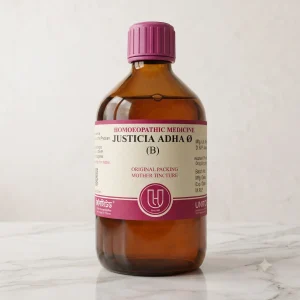


JUSTICIA ADHATODA (ADHATODA VASICA) (JUSTICIA)
450.00৳ Original price was: 450.00৳ .400.00৳ Current price is: 400.00৳ .
- Drug Nomenclature: Justicia adhatoda (or Adhatoda vasica / Adhatoda vasica nees)
- Common/Vernacular Names: Malabar Nut, Vasaka, Bakas
- Botanical Family: Acanthaceae
- Primary Miasmatic Affinity: Psora and Sycosis
Key Product Highlights
✓ Supports healthy respiratory system function and relieves bronchial distress.
✓ Highly useful in managing acute bronchitis, spasmodic asthma, and whooping cough.
✓ Relieves severe, suffocative coughs with tight chest constriction.
✓ Effectively addresses fluent coryza accompanied by continuous sneezing and tear
formation.
✓ Assists in liquefying tough, tenacious sputum and promoting easy expectoration.
✓ Helpful in early stages of respiratory fevers and post-influenza debility.
✓ Addresses post-nasal catarrh and sinus congestion
✓ Useful in flatulent dyspepsia and digestive disturbances
✓ Beneficial in spasmodic and paroxysmal cough
✓ Prepared strictly in accordance with Homoeopathic Pharmacopoeial standards
More Products from This Brand

JUSTICIA ADHATODA (ADHATODA VASICA) (JUSTICIA)
450.00৳ Original price was: 450.00৳ .400.00৳ Current price is: 400.00৳ .
- Description
- Key Benefits
- Spheres of Action & Modern Pharmacological
- General Indication & Clinical Indication
- Homoeopathic Profile (Guiding Symptoms)
- Potency Guidelines & Precaution
- Frequently Asked Questions (FAQs) & References
- Store Policies
- Inquiries
Description
Overview/ Product Highlights (Benefits and Features)
Justicia adhatoda (Vasaka) is an extensively verified and highly valued indigenous remedy within
Homoeopathic literature, recognized for its specific, profound affinity for the respiratory tract and
its mucous membranes. Prepared from the fresh leaves of the plant, this medicine has marked affinity
on the bronchial tree, pulmonary tissue, and respiratory centers to relieve spasm, liquefy tenacious
exudates, and soothe irritated mucous membranes.
Justicia MT has an extensive sphere of action on the respiratory organs, nervous apparatus, and
vascular systems. It is primarily used in cases of acute catarrhal conditions of the respiratory tract,
spasmodic coughs, bronchitis, asthma, and early stages of phthisis.
Justicia Adhatoda MT is useful for curing many catarrhal conditions of the respiratory system. It is
a great expectorant and soothes teasing cough in coryza, pneumonea, bronchitis, phthisis and clears
the lungs. It is also beneficial in the first stage of phthisis and all kinds of pulmonary diseases with
discharge of blood in the phlegm. It is very effective in whooping cough of children with gagging
after coughing, stiffness of body, face cyanotic and constipation. Recent study has shown that the
methanolic extract of this drugs was effective against S. Typhimurium, thus confirming its antibacterial effect.
The drug has proved its worth in the first stage of acute bronchitis, whooping cough, paroxysmal
asthma, bronchopneumonia, and catarrhal fevers. It acts as an excellent expectorant, bronchodilator,
anti-spasmodic, and mild febrifuge. Research has shown that it possesses profound anti-tussive,
mucolytic, and anti-microbial actions. The active alkaloidal constituents, principally vasicine and
vasicinone, act as natural modulators for bronchial smooth muscles. Recent studies have also
validated its significant antioxidant, anti-inflammatory, and mast-cell stabilizing properties, making
the drug as a whole highly beneficial for reversing states of respiratory congestion and
hypersensitivity.
In Homoeopathy, the drug was introduced by Dr. S. C. Ghose and is covered by Boericke’s materia
medica, Robin Murphy’s Homoeopathic Remedy Guide, and S.R. Phatak’s Materia Medica of
Homoeopathic Medicines and verified through scientific drug provings by the Central Council for
Research in Homoeopathy (CCRH), it stands out as a highly effective valuable respiratory remedy
and alterative.
Key Benefits
- Targeted Respiratory Stabilization: Acts as an excellent therapeutic stabilizer for
bronchial irritability, may build up the cellular resistance of respiratory mucosal linings. - Mucolytic and Expectorant Regulation: Facilitates the loosening of thick, yellow, or pluglike mucus from the bronchioles, reducing chest pain during expectoration.
- Paroxysmal Spasm Alleviation: Restores the vital force during violent, paroxysmal cough
fits that lead to vomiting, cyanosis, or catching of the breath. - Vascular Matrix and Hemostasis: Exerts a clear dynamic action on the pulmonary capillary
network to check active capillary bleeding, blood-streaked sputum, and epistaxis. - Anti-inflammatory Action: Reduces inflammation of the respiratory mucosa, throat, and
tonsils; useful in pharyngitis and tonsillitis. - Bronchodilator Effect: Relieves bronchospasm and dyspnoea, making it valuable in
asthmatic conditions. - Immunomodulatory: Demonstrates anti-inflammatory and antioxidant properties mediated
through NF-κB and AP-1 pathways - Astringent and Strengthening: Helps retain respiratory vital capacity, tones bronchial
fibers.
Available Pack Size
- Mother Tincture (MT): 30 ml, 100 ml, 450 ml
- Dilutions/Potencies: 30 ml
Composition
- For Mother Tincture (MT): Each ml contains Justicia adhatoda fresh leaves (Drug strength
1/10) matching Homoeopathic Pharmacopoeia of India (HPI) standards.
Alcohol Content
- Mother Tincture (MT): High-grade pure extra neutral alcohol (ENA) base, approximately
60% to 70% v/v. - Dilutions: Approximately 90% v/v dispensing alcohol base.
Spheres of Action
- Respiratory System & Bronchial Axis: The primary seat of action. It has marked affinity
upon the bronchial mucosa, tracheal rings, and pulmonary parenchyma, correcting structural
torpor, severe congestion, and functional exhaustion of respiratory membranes. - Nasal & Ocular Mucosa: Exerts a distinct irritant action in crude forms, which
Homoeopathically resolves intense fluent coryza, continuous sneezing, and lachrymation. - Vascular System & Pulmonary Capillaries: Exerts a clear dynamic action on the vascular
network to check capillary oozing, dark or bright red hemorrhages from the lungs, nose, or
lower bowels. - Immune & Inflammatory Pathways: Demonstrates anti-inflammatory and antioxidant
properties - Gastrointestinal System: Action on the digestive tract, correcting flatulent colic, vomiting
accompanying severe cough paroxysms. - Nervous System: Regulating dyspnea and sympathetic reflex cough triggers.
Pharmacology & Phytochemistry
The Homoeopathic pathogenetic profile of Justicia adhatoda correlates well with its complex natural
chemistry. The leaves contain high concentrations of quinazoline alkaloids, essential oils, and
organic mineral salts.
Major Phytoconstituents
- Quinazoline Alkaloids (Vasicine, Vasicinone, Adhatodine, Vasicinol)
- Essential Oils & Alcohols
- Flavonoids and Phytosterols
- Adhatodic Acid
- Essential organic potassium and calcium salts
Modern Pharmacological Actions
Experimental and clinical screenings support its traditional and Homoeopathic usage:
- Bronchodilatory & Mucolytic Activity: Vasicine undergoes conversion to auto-oxidation
products that act as a potent bronchodilator and lower mucus viscosity, mimicking
bromhexine development. - Anti-tussive effect: Stimulates vagal receptors and suppresses the medullary cough center,
reducing the frequency of paroxysmal cough fits. - Anti-inflammatory Activity: Methanolic extract of J. adhatoda inhibited NF-κB and AP-1
expression in THP-1 cells to a greater extent than the positive control prednisolone . This
mechanism underpins its traditional use in inflammatory respiratory conditions. - Antioxidant Activity: Demonstrates significant anti-carotene bleaching activity, higher than
the reference BHT; moderate radical-quenching properties observed in DPPH and ABTS
assays - Anti-asthmatic Properties: Traditional use as cardiotonic, expectorant, anti-asthmatic, and
bronchodilatory is well-documented - Mast-Cell Stabilization & Anti-allergic: Inhibits antigen-induced degranulation of mast
cells, reducing histamine release in allergic asthma and rhinitis. - Anti-microbial & Immunomodulatory: Enhances alveolar macrophage activity while
suppressing pro-inflammatory pathways, aiding clearance of respiratory pathogens.
General Indication
- Severe, violent, paroxysmal cough with tight suffocation and inability to expectorate tough
mucus, causing the patient to turn blue in the face. - Acute, profuse, fluent coryza with constant, violent sneezing, watering from eyes, and a dull,
heavy frontal headache. - Spasmodic respiratory conditions like asthma or whooping cough where every breath feels
obstructed, worse in a warm closed room. Bronchitis and asthmatic conditions. - Coryza with thin, watery profuse discharge
- Hoarseness of voice
- Dyspnoea and difficulty breathing
- Tonsillitis and sore throat
- Flatulence and abdominal distension
- Constipation with hard, dry stools
Clinical Indication
- Acute and chronic bronchitis (bronchial catarrh) with thick expectoration, yellow, worse at
night - Spasmodic bronchial asthma and asthmatic dyspnea
- Whooping cough (pertussis) and laryngitis
- Allergic rhinitis (hay fever) and influenza
- Hemoptysis (blood-spitting) and epistaxis (nosebleeds)
- Pharyngitis and Tonsillitis: Pain in throat; worse on swallowing
- Hoarseness of Voice: Worse after coughing
- Catarrhal fevers with respiratory complications
- General respiratory debility and post-cough prostration
Homoeopathic Profile (Guiding Symptoms)
As per Homoeopathic Materia Medica
- Mind: The patient is easily vexed, hyper-sensitive to noise, and displays an inability to
perform mental work due to continuous physical suffering and a clouded intellect. - Head: Dull, heavy, constant frontal headache, focused heavily across the brows or root of
the nose. This headache is characteristically a reflex symptom of suppressed catarrh or severe
coryza, worsening from mental exertion, iron stove heat, or closing the room, and improving
from open air. - Gastric System: Loss of appetite, complete aversion to food, and a white-coated tongue.
Flatulent distension of the abdomen with severe griping umbilical pains. Vomiting of mucus
and food invariably occurs during or immediately following a violent paroxysm of coughing. - Urinary System: High-colored urine passed with a mild burning sensation in the urethra due
to localized febrile concentrations. - Nasal & Respiratory Organs: Dryness of nose followed by profuse, acrid, fluent coryza
with incessant sneezing. Severe hoarseness and laryngeal tenderness. Cough is dry,
spasmodic, deep-seated, and comes on in paroxysms. The chest feels tight, full, and
completely obstructed; the patient is forced to sit up, gasping for breath. Sputum is tough,
yellowish-white, or blood-streaked, and hard to detach.
Red-Line Homoeopathic Keynotes
- The “Suffocative Paroxysmal” Cough: Violent, agonizing fits of coughing where the chest
is so tightly filled with mucus that the patient turns blue, gasps for air, and feels on the verge
of suffocating because the phlegm cannot be detached. - Spasmodic, Barking Cough: Dry, spasmodic, barking cough with rattling in the chest;
worse in the morning, evening, and night. - Coryza with Constant Sneezing: Thin, watery profuse nasal discharge with constant
sneezing and loss of smell; worse in the morning and evening. - Cough with Vomiting of Mucus: Paroxysmal cough followed by vomiting of mucus .
- Frontal Headache Ameliorated by Pressure: Heavy, bursting catarrhal headache localized
in the forehead and root of the nose, aggravated by heat and significantly relieved by tight,
firm hand pressure. - Cough Aggravated Lying Down: The spasmodic cough fits are instantly triggered or
worsened the moment the patient attempts to lie down flat in bed or enters a warm,
unventilated room. - Hemoptysis with Spasmodic Cough: Coughing up of bright red, frothy blood or bloodstreaked tenacious mucus during acute bronchial or asthmatic paroxysms.
- Tonsillitis Worse on Swallowing: Pain in the throat with tonsillitis aggravated by
swallowing - Flatulence with Heaviness: Distension of the abdomen with flatulence, passing flatus
provides relief . - Dust Sensitivity: Respiratory complaints triggered by exposure to dust; catches cold easily
Dosage and Administration
Adults:
- 5–15 drops in $\frac{1}{4}$ cup of water, 2–3 times daily, or as directed by a
qualified Homoeopathic physician.
Potencies
- Mother Tincture (MT): Most frequently indicated in classical literature for loosening thick
phlegm, aborting paroxysmal asthma attacks, checking hemoptysis, and acting as a direct
bronchial expectorant. - 3X to 6X: Chosen for chronic catarrhal bronchitis, lingering coughs, and structural changes
in the bronchial membranes. - 30C to 200C: Indicated for acute, highly hyper-sensitive states (like hay fever, continuous
allergic sneezing, acute whooping cough spasms, or matching constitutional profiles).
Safety Information
- Carefully read the product label before using.
- Keep out of the reach and sight of children.
- Store in a cool, dry place away from direct sunlight, strong aromatic compounds (such as
camphor, menthol, or musk), and electromagnetic fields.
Side Effects
- Generally non-toxic and free from adverse reactions when taken in recommended potentized
Homoeopathic micro-doses or standard diluted mother tincture frameworks. - Unusually large, unmitigated doses of the raw mother tincture may cause mild temporary
nausea, vomiting, or gastric irritation due to the active emetic-like properties of concentrated
quinazoline alkaloids.
Contraindication
❌ No absolute contraindications reported in Homoeopathic literature for potentized preparations
- Individual sensitivity to any component of the remedy
- Medical supervision recommended during pregnancy and lactation
Precaution
- Carefully read the product label before using.
- Keep out of the reach and sight of children.
- Store in a cool, dry place away from direct sunlight, strong aromatic compounds, and
electromagnetic fields. - Maternal Use: For the intake of potentized preparations during pregnancy or lactation,
women should seek a formal clinical evaluation from a registered professional Homoeopath
before starting therapy. Avoid self-medication with Mother Tincture during pregnancy
because traditional herbal literature reports uterine activity. - Pregnancy and Lactation: Consult a qualified Homoeopathic physician before use.
- Maintain a clean mouth environment; avoid consuming food, drinks, or brushing teeth for at
least 15 to 20 minutes before and after taking the medicine. - If symptoms do not improve in 4 days, or worsen, discontinue use and seek assistance of
a health professional .. - Oral Hygiene: Maintain a clean mouth environment; avoid consuming food, drinks, or
brushing teeth for at least 15 to 20 minutes before and after taking the medicine. - Alcohol Sensitivity: Individuals with verified alcohol sensitivity or liver restriction protocols
should avoid liquid drops and receive the medicine exclusively via sucrose globules or
lactose tablets.
Frequently Asked Questions (FAQs)
- Is Justicia safe for children?
Homoeopathic preparations are generally safe when prescribed by a qualified practitioner. It
is highly effective in pediatric whooping coughs and catarrhal fevers, but a physician should
always be consulted for correct dosage. Always consult a qualified Homoeopathic
practitioner. - Is it useful in cough with mucus?
The remedy is traditionally associated with cough accompanied by abundant expectoration
and bronchial catarrh - Can Justicia help with anxiety?
Justicia is primarily a respiratory remedy. Any mild anxiety it addresses is secondary to
severe air hunger, chest constriction, and the fear of suffocation during acute asthmatic or
spasmodic cough attacks - Is it safe during pregnancy?
Mother Tincture/extract is not recommended. Traditional sources recommend consulting a
healthcare practitioner prior to using potentized medicine during pregnancy. Always seek
professional Homoeopathic advice. - How long should I take Justicia adhatoda for a cough?
If symptoms do not improve in 4 days, or worsen, discontinue use and seek assistance of a
health professiona - Can Justicia be taken for a long time?
In Homoeopathic preparations, especially in potencies, it can be taken safely under
professional supervision. The CCRH provings confirmed the safety of the drug when aligned
with individual pathogenetic indications. - What conditions is Ashoka/Vasaka used for in traditional medicine?
In Ayurveda and Siddha, Vasaka is extensively used for Kasa (cough), Shwasa (asthma),
Raktapitta (bleeding disorders), bronchitis, localized inflammations, consumption, and
catarrhal fevers. - Is Justicia Adhatoda the same as Herbal/ Unani/ Ayurvedic Vasaka?
The source plant is the same, but Homoeopathic preparations are manufactured and
prescribed according to Homoeopathic pharmacopoeial principles.
Dr. William Boericke (9th Edition, Manual of Materia Medica)
“Under Justicia adhatoda: A highly efficacious remedy for acute catarrhal conditions of the
respiratory tract… Coryza with constant sneezing. Severe dyspnea; cough with tightness across chest.
Whooping cough.”
Dr. S.C. Ghose (Drugs of Hindustan)
“Justicia adhatoda is an exce llent remedy which matches the clinical virtues of Ipecacuanha and
Antimonium tartaricum combined. It has a marvelous influence over the bronchial mucous
membrane, loosening thick phlegm, checking active hemorrhages from the lungs, and restoring easy
breathing when a patient turns cyanotic from severe coughing fits.”
References
- Boericke, W. (1927). Pocket manual of Homoeopathic materia medica. Boericke & Runyon.
- Central Council for Research in Homoeopathy. (1995). Homoeopathic Drug Provings.
CCRH Publications, New Delhi. - Ghose, S. C. (1902). Drugs of Hindustan. Hahnemann Publishing Office, Calcutta.
- Government of India. (1986). Homoeopathic Pharmacopoeia of India (HPI), Volume VIII.
Ministry of Health and Family Welfare. - Verma, P. N., & Vaid, I. (2002). Materia medica of common Homoeopathic remedies. Jain
Publishers. - Nadkarni KM. Indian Materia Medica.
- The Wealth of India (CSIR).
- WHO Monographs on Medicinal Plants.
- Reviews on Justicia adhatoda phytochemistry and pharmacology.
- Dr. Willmar Schwabe India website data guidelines.
Disclaimer: This information is for educational and professional reference purposes only and does
not constitute medical advice. Please consult a qualified Homoeopathic practitioner for personalized
treatment. Homoeopathic medicines should be used as per the advice of a registered medical
practitioner. The indications, doses, and safety information are based on available Homoeopathic
literature and traditional knowledge; individual patient assessment is essential for safe prescribing.
General Inquiries
There are no inquiries yet.

Reviews
There are no reviews yet.