
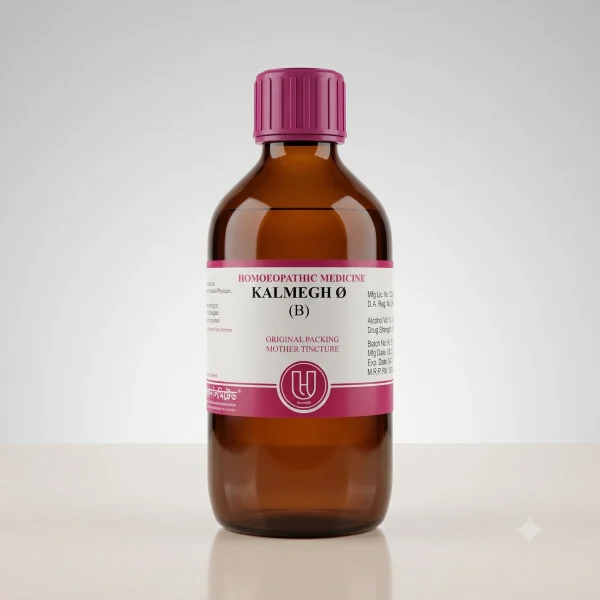


Andrographis Paniculata (Kalmegh)
450.00৳ Original price was: 450.00৳ .400.00৳ Current price is: 400.00৳ .
- Primary Benefits: Hepatoprotective, immunomodulatory, antipyretic, and digestive support
- Key Indication: Liver disorders, intermittent fevers, common cold, and dysentery
- Traditionally known as: Kalmegh (Ayurveda), Nilavempu (Siddha), “King of Bitters”
- Historical use: Used in Bengal as “Alui” for infantile colic and griping
- Clinical validation: CCRH double-blind proving validated new and reproved symptoms
Key Product Highlights
✓ Supports healthy liver function
✓ Useful in hepatic congestion and enlarged liver
✓ Helpful in jaundice and bilious disorders
✓ Assists recovery after recurrent or prolonged fevers
✓ Relieves bitter taste, loss of appetite and digestive weakness
✓ Useful in intermittent and remittent fever patterns
✓ Addresses post-febrile debility and exhaustion
✓ Prepared according to Homoeopathic Pharmacopoeial standards
More Products from This Brand
Andrographis Paniculata (Kalmegh)
450.00৳ Original price was: 450.00৳ .400.00৳ Current price is: 400.00৳ .
- Description
- Key Benefits
- Spheres of Action & Modern Pharmacological
- General Indication & Clinical Indication
- Homoeopathic Profile (Guiding Symptoms)
- Potency Guidelines & Precaution
- Frequently Asked Questions (FAQs) & References
- Store Policies
- Inquiries
Description
Overview/ Product Highlights (Benefits and Features)
Andrographis paniculata is a well-recognized medicinal plant traditionally known for its affinity towards the liver, gastrointestinal system and febrile conditions. The Homoeopathic medicine prepared from the fresh plant has demonstrated marked action on hepatic functions, digestive disturbances, intermittent fevers and states of debility.
The drug has proved its worth in the first stage of cold and cough; convalescence after prolonged fever; general debility, infantile liver and jaundice. The plant is febrifuge, tonic, alternative, anthelmintic. It is useful in dysentery and dyspepsia. Favourable research on inflammation of liver of viral origin, on liver, fights toxins, and anti-ulcer activity.
Key Benefits
- Targeted Hepatic Support: Acts as an excellent therapeutic stabilizer for an enlarged, sluggish, or fatty liver, accelerating bile expression and reducing right hypochondrial soreness.
- Gastrointestinal Restoration: Regulates irregular peristalsis, checks alternate states of diarrhea and constipation, and flatulent distension.
- Pyrexial and Post-Febrile Recovery: Effectively breaks low-grade intermittent and bilious fevers while eliminating the accompanying post-febrile weakness and mental exhaustion.
- Natural Immune Defense: Acts as an acute immunomodulatory agent that helps the vital force clear toxic heat during severe catarrhal colds, coryza, and influenza.
Available Pack Size
- 30 ml, 100 ml, 450 ml (Mother Tincture); 30 ml (Dilution)
Composition
- For Mother Tincture (MT): Each ml contains Andrographis paniculata aerial parts and roots(Drug strength 1/10) matching Homoeopathic Pharmacopoeia standards.
- For Dilutions: Potentized Andrographis paniculata liquid in specific Decimal and centesimal scales dispensed in purified water and dispensing alcohol.
Alcohol Content
- Mother Tincture (MT): High-grade pure extra neutral alcohol (ENA) base, approximately 60% to 70% v/v.
- Dilutions: Approximately 90% v/v dispensing alcohol base.
Spheres of Action
- Liver and Portal System: Primary seat of action; prompts the functional tissue of the liver to
optimize bile production, decreases portal congestion, and corrects metabolic sluggishness. - Gastrointestinal Tract: Directly targets the mucous membrane of the stomach, duodenum, and intestines to modulate functional secretions and alleviate hyper-flatulence.
- Thermoregulatory & Immune Systems: Acts on the centers regulating heat distribution and the blood plasma, facilitating the expulsion of toxins during fevers and acute upper respiratory tract infections.
Pharmacology & Phytochemistry
The Homoeopathic pathogenetic expression of Andrographis paniculata maps elegantly to its underlying complex plant chemistry. The herb contains high concentrations of bitter diterpene lactones, most notably andrographolide, neoandrographolide, and dehydroandrographolide, alongside supportive flavonoids and polyphenols
Major Phytoconstituents
- Andrographolide
- Neoandrographolide
- Deoxyandrographolide
- Diterpene lactones
- Flavonoids
- Polyphenols etc.
Modern Pharmacological Actions
Experimental studies have demonstrated:
- Hepatoprotective activity
- Anti-inflammatory effects
- Antipyretic action
- Immunomodulatory activity
- Antioxidant activity
- Choleretic action
- Gastroprotective effects
These pharmacological observations correlate with the traditional and Homoeopathic clinical use of the medicine in hepatic disorders, digestive disturbances and fever conditions.
– General Indication
- Sluggish liver functions, loss of appetite, and chronic indigestion accompanied by a heavy, whitecoated tongue.
- Acute coryza, influenza, and recurring respiratory tract infections brought on by seasonal shifts.
- General debility, physical prostration, and low vital tone during recovery from debilitating acute
fevers.
Clinical Indication
- Hepatomegaly (enlarged liver)
- Infantile and adult Jaundice
- Fatty Liver (Hepatic Steatosis)
- Infantile flatulent colic and griping
- Anorexia and dyspepsia
- Malarial or intermittent fevers
- Acute Coryza and Sore Throat
As per Homoeopathic Materia Medica
Red-Line Homoeopathic Keynotes
- The “Alui” Infant State: Pediatric loss of appetite accompanied by griping abdominal colic,where the infant habitually draws its legs up toward the abdomen for relief, which is temporarily granted by passing highly offensive flatus (Rajpal et al., 2011).
- Intense, Pervasive Bitterness: A clinical presentation where all food items taste intensely bitter, or conversely, a total loss of taste perceptions during advanced acute coryza.
- Right Hypochondrial Soreness: Sharp, stitching pains localized in the liver region; the patient cannot tolerate any tight clothing or pressure around the waistline.
Dosage and Administration
Adults:
- 5–15 drops in ¼ cup of water
- 2–3 times daily
Or as directed by a qualified Homoeopathic physician
Potencies
- 3X to 6X: Functional hepatic and digestive disorders
- 30C: Symptomatic prescribing
- 200C and above: Constitutional prescribing under professional supervision
Safety Information
- Carefully read the product label before using.
- Keep out of the reach and sight of children.
- Store in a cool, dry place away from direct sunlight, strong aromatic compounds (such as camphor, menthol, or musk), and electromagnetic fields.
Side Effects
- When taken in recommended potentized Homoeopathic micro-doses or standard mother tincture dilutions, it is generally non-toxic and free from adverse reactions.
- Unnecessarily high or frequent doses of the raw mother tincture may cause temporary stomach irritation or transient taste blunting due to its highly concentrated bitter principles.
Contraindication
Based on herbal pharmacology literature: (Crude/ extract/ Mother Tincture)
❌ Avoid use if there is a known hypersensitivity to plants in the Acanthaceae family.
❌ PREGNANCY (uterine stimulant; anti-implantation effect)
❌ LACTATION (insufficient data)
❌ Known hypersensitivity to Acanthaceae family
❌ Organ transplant recipients (may promote graft rejection)
❌ Concurrent anticoagulant therapy (potentiates warfarin) etc.
Precaution
- Pregnancy: Mother Tincture/ crude drug/ extract contraindicated (traditionally used as
abortifacient) - For intake of potency (dilution), Pregnant or lactating women should seek a formal consultation from a registered professional Homoeopath before beginning therapy.
- Maintain a clean mouth environment; avoid consuming food, drinks, or brushing teeth for at least 15 to 20 minutes before and after taking the medicine.
- Monitor blood glucose (diabetics) · Monitor INR (anticoagulants) · Discontinue 2 weeks presurgery · Caution driving (mild sedation) · Alcohol-sensitive patients → use globules/tablets
- Is Andrographis Paniculata safe for long-term use in chronic fatty liver?
Yes. In Homoeopathic preparations, especially in the $6\text{C}$ or $30\text{C}$ potencies, it can be taken safely for several weeks to gently regulate liver function without inducing drug dependency or systemic toxicity. - Can this remedy be used alongside conventional allopathic medicines?
Yes, Homoeopathic medicines operate on a dynamic, non-biochemical plane and do not interfere with allopathic treatments. It is recommended to maintain a 30-minute interval between different lines of medication. - Why is Andrographis Paniculata often called “Kalmegh” or “Bhui-Neem”?
“Kalmegh” is its traditional name across the Indian subcontinent. It is called “Bhui-Neem” (ground neem) because its aerial parts possess an incredibly intense bitter profile that closely mirrors the taste of the traditional Neem tree (Azadirachta indica).
Expert Opinion / Homoeopathic Stalwart’s / Doctor’s Note
Dr. William Boericke (9th Ed.): “Acts on the liver and spleen…particularly indicated in enlarged liver and spleen, intermittent fevers, and worm affections of children…one of the most useful remedies in bilious and malarial conditions of tropical countries.”
Dr. P.N. Verma (Encyclopaedia of Homoeopathic Pharmacopoeia): describes as a polychrest of tropical medicine…the keynote of intensely bitter taste in the mouth, combined with right-sided hepatic pain and periodic fever, makes this one of the most easily recognisable and prescribable remedies in the IndianHomoeopathic Materia Medica.
CCRH Official Commentary: “Well-proved, clinically validated Homoeopathic remedy…included in HPI…recommended for hepatic disorders, febrile states, and gastro-intestinal complaints.” (IJRH Vol. 5, No. 2, 2011)
References
- Boericke, W. (1927). Pocket manual of Homoeopathic materia medica. Boericke & Runyon.
- Central Council for Research in Homoeopathy. (2000). Drug standardization of indigenous medicinal plants: Andrographis paniculata. CCRH Quarterly Bulletin, 22(1-2), 15–22 (Sexena, 2016).
- Rajpal, Singh, V., Dutta, B., Das, S., Mal, P., Bhakat, A., Roy, R., & Chaudhary, C. (2011). Andrographis paniculata – A multicentric, randomized, double-blind Homoeopathic pathogenetic trial. Indian Journal of Research in Homoeopathy, 5(2), 9–14. https://doi.org/10.53945/2320- 7094.1715
- Verma, P. N., & Vaid, I. (2002). Materia medica of common Homoeopathic remedies. Jain Publishers.
- Hering, C. Guiding Symptoms of Our Materia Medica, Vol. I. B. Jain, New Delhi.
- Verma, P.N. Encyclopaedia of Homoeopathic Pharmacopoeia, Vol. I. B. Jain, New Delhi.
- Dr. Willmar Schwabe India website
Disclaimer: This information is for educational and professional reference purposes only and does not constitute medical advice. Please consult a qualified Homoeopathic practitioner for personalized treatment. Homoeopathic medicines should be used as per the advice of a registered medical practitioner. The indications, doses, and safety information are based on available Homoeopathic literature and traditional knowledge; individual patient assessment is essential for safe prescribing.
General Inquiries
There are no inquiries yet.

Reviews
There are no reviews yet.